Whatever Yours Is Called, It Comes Off the Same Way
People call it different things depending on who sold them the house. Popcorn ceiling, acoustic ceiling, cottage cheese ceiling, stipple, stomp, swirl — in a Amarillo home built between 1950 and 1979, these are all describing spray-applied or troweled ceiling texture from the same era and the same construction habit.
The removal is the same job. The ceiling gets tested if the home is old enough, the room gets contained, the texture comes off wet or gets skim coated over, the drywall underneath gets repaired, and you choose what goes back on.
Telling Them Apart
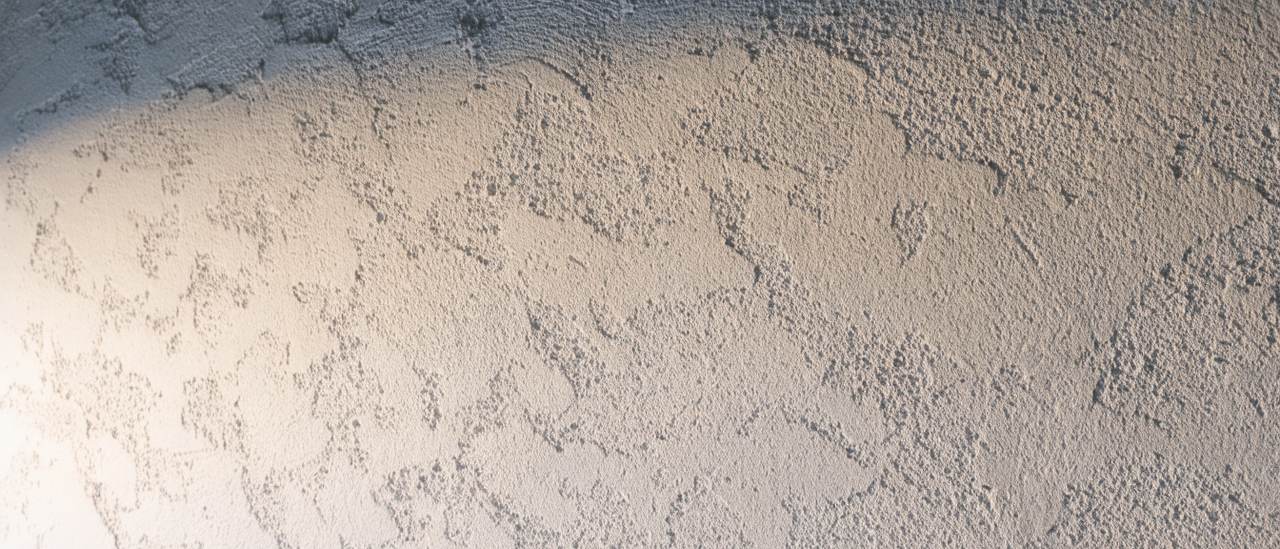
- Popcorn / acoustic / cottage cheese. Heavy sprayed texture with distinct raised peaks that crumble if you rub them. The classic postwar ceiling, and the one most people want gone. Genuinely was sold partly for sound absorption, which is where “acoustic” comes from.
- Stipple. A finer sprayed texture, lower profile than popcorn but still peaked. Same removal approach.
- Stomp, swirl, and rosebud. Applied with a brush or crows-foot stamp rather than sprayed, leaving a repeating pattern. These are usually skim coated flat rather than scraped, because there is less material to remove and more pattern to bury.
- Knockdown. Sprayed then flattened with a blade. Mostly a later finish, and more often what people choose as a replacement than something they want removed.
- Orange peel. Fine spatter, no peaks. Rarely removed; commonly chosen as a modern replacement.
Scraping Versus Skim Coating
There are two ways to get rid of a textured ceiling, and the right one depends on the texture and what is under it.
Scraping suits heavy sprayed texture that has never been painted. It is misted with water, comes off in sheets, and leaves bare drywall that then gets skim coated flat. Most efficient route when it works.
Skim coating over the top suits lighter textures, troweled patterns, and painted popcorn that will not release. Joint compound goes on in passes over the existing texture until the surface is flat. It avoids the scrape mess entirely and, over large square footage, is sometimes both faster and cheaper. It does add weight, so the drywall and framing underneath need to be sound.
On a pre-1980 ceiling that tests positive, skim coating has an additional advantage: it leaves the original material undisturbed. That is a legitimate strategy, not a shortcut.
Why Amarillo Has So Many of These Ceilings
Textured ceilings were not a style choice so much as a construction shortcut, and Amarillo was built at exactly the moment the shortcut was standard. A city that went from roughly 16,000 people to around 123,000 in about fifteen years had to put up housing fast, and sprayed ceiling texture let a crew finish a ceiling in one pass without taping and sanding it to a flat plane.
That is why the texture is so consistent across whole neighborhoods here. It was not chosen room by room; it was how the subdivision was built. It is also why removing it so often reveals rough drywall work underneath — the texture was doing exactly the job it was sprayed on to do.
The Pre-1980 Question Applies to All of Them
The material era matters more than the pattern. A stipple ceiling sprayed in 1968 warrants exactly the same testing as a popcorn ceiling sprayed in 1968, and about 44% of Amarillo’s housing stock is old enough for the question to be live. The asbestos page covers what Texas actually requires, which is narrower than most national sites claim.